Care Training E-Learning vs Face-to-Face: How to Choose On-Site, Open Course or Online Learning
6 min read
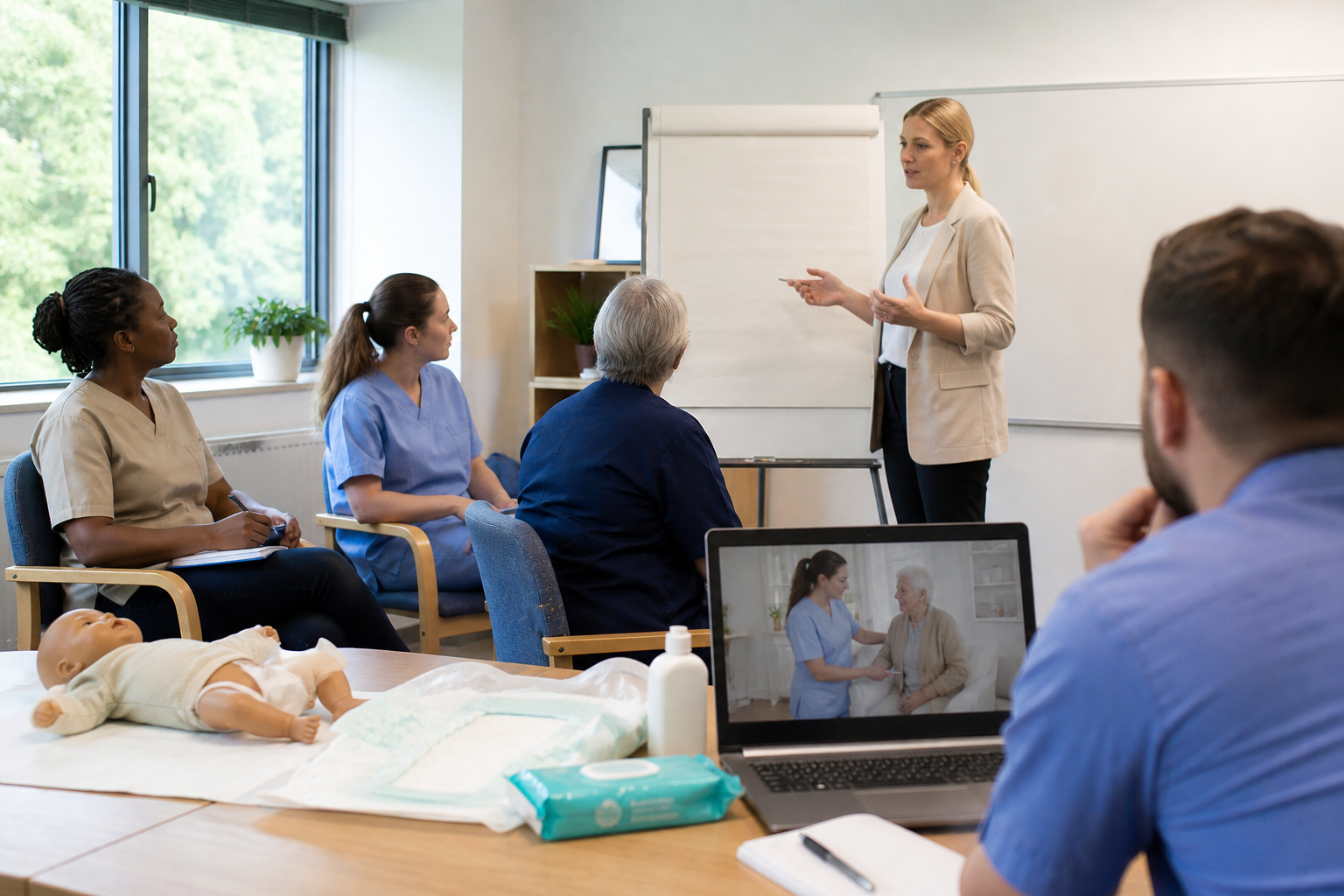
Choosing between care training e-learning vs face-to-face delivery is not just a question of convenience. For care and healthcare organisations, the format you choose affects attendance, engagement, practical confidence and how easily staff can apply what they have learned in day-to-day work.
At Train to Care Limited, we provide face-to-face open courses and client on-site training, alongside online CPD and other approved e-learning courses. That means we can help organisations compare the options properly and choose a route that suits the subject, the team and the realities of service delivery.
If you are deciding between on-site training, an open course or online learning, here is what to consider before you book.
Care training e-learning vs face-to-face: what really matters?
The best format depends on more than the course title. In most cases, there are four practical questions to ask first.
1. What outcome do you need?
Some training is mainly about knowledge, awareness and understanding. Other training works best when staff can ask questions in real time, discuss scenarios or practise a skill under guidance.
E-learning can work well for theory-led topics and refresher knowledge.
Face-to-face training is often more suitable where discussion, demonstration or practical application matters.
On-site delivery is useful when you want training shaped around your own working environment.
Open courses are practical when only one or two people need training.
2. How many people need training?
If you need to train a full team, bringing a trainer to your setting can be more practical than sending staff out individually. If you only need a few places, an open course may make more sense.
3. Is there a practical element?
This is often the deciding factor. If learners need to demonstrate a skill, take part in scenario-based learning or build confidence through guided practice, face-to-face delivery usually adds value.
4. How much flexibility do you need?
Shift patterns, staffing pressures and multiple locations can all affect the right choice. E-learning can be easier to roll out across a busy workforce, while face-to-face formats may need more planning but offer more direct interaction.
When on-site training is the right choice
Client on-site training works well when you want a group trained together in your own setting. It can be especially useful for organisations that want a consistent message across the team or need the learning to reflect real working practice.
On-site training is often worth considering when:
you want several staff members trained at the same time
you need to reduce staff travel and time away from site
you want the trainer to understand your working environment
the subject benefits from group discussion or practical input
you want managers and staff to hear the same guidance together
This route can be a strong fit for organisations looking at mandatory care training and clinical skills training, particularly where relevance and team consistency matter.
Another advantage is engagement. Staff often find it easier to ask questions when the examples relate directly to their own service, policies and day-to-day responsibilities.
When an open course makes more sense
Open courses are ideal when you do not need a full group session. If you only have one new starter, one manager or a small number of staff who need a course, booking individual places can be the simpler option.
An open course may be the right fit if:
you only need training for one or two people
you want access to a scheduled date without organising an in-house session
you do not have suitable space to host training on-site
your team members need training at different times
an individual needs to join a course independently
This option can be useful for care and healthcare organisations that need flexibility without arranging a full company session. It also reflects the fact that individuals can enrol onto our open courses where that is the better route for the learner.
If you are weighing up individual places against an in-house booking, you can review our face-to-face training options and decide which model offers the best balance of cost, timing and convenience.
When e-learning is the best fit
E-learning is not simply the lower-effort option. Used properly, it can be a highly efficient way to deliver consistent training across a busy team.
Online learning is often a good choice when you need:
flexible access for shift-based staff
training that can be completed across different locations
a consistent learning experience for all learners
support for induction or refresher knowledge
a practical route for theory-led subjects
For example, Train to Care Limited provides online CPD and other approved e-learning courses, and this format can work well for subjects suited to online delivery, including areas such as health and safety training, food hygiene training and e-learning courses.
Where e-learning has limits
E-learning is not always the full answer. It may be less suitable when staff need hands-on practice, immediate feedback or confidence-building through live discussion.
It does not replace practical observation where a skill needs to be demonstrated.
It can be less effective for learners who benefit from guided discussion.
It still relies on staff having time, motivation and suitable access to complete it properly.
That is why the best decision is rarely about what is cheapest in the short term. It is about what helps your team learn well and apply the training appropriately.
For many organisations, a blended approach works best
In practice, the answer to care training e-learning vs face-to-face is often not either-or. A blended approach can give you the strengths of both.
For example, you might use e-learning for background knowledge and then book face-to-face training for discussion, scenario work or practical elements. This can help reduce classroom time while still giving staff the chance to ask questions and build confidence.
A blended model can be especially useful when:
you want staff to complete theory in advance
you need classroom time to focus on application rather than basic knowledge
different roles need different depths of learning
you are balancing quality, budget and operational pressures
How to choose the right training format for your organisation
If you are still unsure, use this simple checklist before booking.
Define the result. Do you need awareness, refresher knowledge, practical confidence or observed competence?
Look at team size. Larger groups often make on-site delivery more attractive, while smaller numbers may suit open courses.
Check the subject. Theory-led topics may suit e-learning. Topics needing practice or discussion often benefit from face-to-face delivery.
Consider your staffing model. If release time is difficult, online learning can offer more flexibility. If consistency across one team matters, on-site training can be more effective.
Think about learner confidence. Some learners engage well online. Others gain more from live teaching and the chance to ask questions straight away.
Plan beyond the booking. The right format should fit how the training will be completed, understood and used in your service, not just how quickly it can be arranged.
When organisations speak to us, this is the kind of guidance we provide. The goal is not to push every enquiry into one format. It is to help you choose the route that is most practical and useful for your team.
Why organisations choose Train to Care Limited
Based in Consett and delivering nationwide, we support care and healthcare organisations with several training routes rather than a one-size-fits-all approach.
We provide face-to-face open courses and client on-site training.
We also offer online CPD and other approved e-learning courses.
Our training includes first aid training, health and safety training, food hygiene training, clinical skills training, mandatory care training, nurse training and fire warden training.
We also offer specialist topics including ADHD training, autism training, dementia training, PMDA training and CHIPS Programme training.
Our Director, Lee Walker, has over 15 years' experience working in training and the health and social care sector.
We hold CPD Accreditation and offer online booking, with buy-and-pay online options available.
For organisations that want training to be engaging, relevant and genuinely useful, having a provider that offers more than one delivery method can make the decision much easier.
Frequently asked questions
Is e-learning enough for mandatory care training?
It depends on the subject and the outcome you need. E-learning can be a practical choice for knowledge-based learning and refreshers, but some areas may benefit from discussion, context or practical input. Many organisations use a mix of online and face-to-face learning for mandatory training.
What is better for a small care or healthcare team: open course or on-site training?
If only one or two people need training, an open course is often the more practical option. If several people need the same training and you want a consistent approach across the team, on-site delivery may be the better fit.
When is face-to-face training usually the stronger option?
Face-to-face training is often stronger when learners need live interaction, scenario-based discussion, practical guidance or support to build confidence. It can also work well when you want training tailored to your service and team.
Can we combine e-learning with classroom training?
Yes. A blended approach can work very well. Online modules can cover background knowledge, while face-to-face sessions focus on discussion, practical application and questions from staff.
How do we choose the most suitable route for our organisation?
Start with the training objective, the number of learners, the subject matter and the practical realities of staffing. If you are unsure, speak to a provider that offers open courses, on-site delivery and online learning so you can compare the options properly.
Need help choosing the right format?
If you are deciding between on-site training, an open course or e-learning, we can help you match the format to your subject, team size and operational needs.
Ask Train to Care Limited which training format best suits your organisation, or email info@t2c.uk to discuss your care or healthcare training needs.